 |


Einar Kjartansson
Motion of sources or receivers, relative to the medium of wave propagation, causes a shift in the frequency of the measured waveforms, Doppler shift.
The speed of marine seismic vessels is typically around 1/600 of the speed of sound in water. The resulting frequency change is small, but can result in significant relative phase shifts in vibroseis data where the source lasts several seconds.
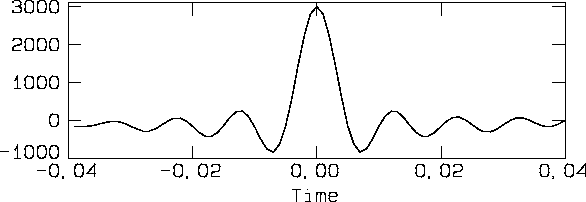
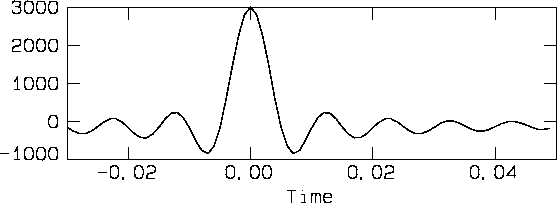
Figure 1 shows the autocorrelation for a 6 second linear sweep from 5 to 100 Hz.
If the source is moving away from the receivers at a velocity of 2.5 m/s, it will move 15 m in 6 seconds. In a medium with a velocity of 1500 m/s this results in a 10 ms longer observed sweep.
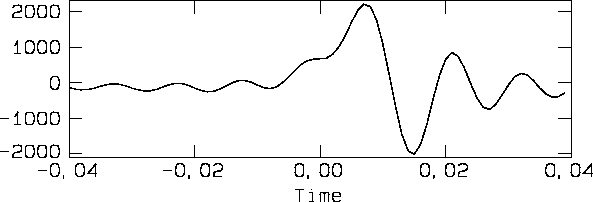
Figure 2 shows the result of correlating the same sweep as used in Figure 1 with a modified sweep that has been stretched by 10 ms.
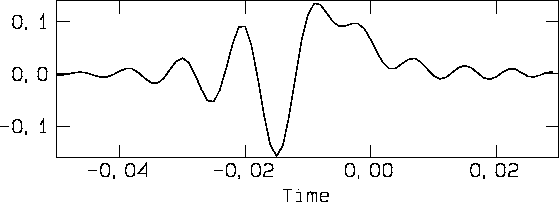
A correction filter that is computed using least-squares to predict the original sweep from the stretched version, is shown in Figure 3. Figure 4 shows the result of applying this filter to the waveform in Figure 2.
Doppler effects in seismic reflection data are caused both by motion of sources and receivers. For horizontal reflectors, both contributions are of the same magnitude but opposite sign, so the two cancel each other. It is relatively straightforward to correct for the effects of receiver motion, by resampling the data to what would be recored using stationary receivers. This is possible because data is usually not spatially aliased in the receivers.
This is generally not the case for the sources. It is possible to apply filters to correct for Doppler effects due to moving sources. The correction depends on the direction of the wave or ray at the source. There is no effect for vertical rays, as the wave then travels perpendicular to the motion of the source. Through the use of dipfilters, waves leaving the source at different angles may be processed separately.
This requires decomposing the data according to the direction of
wavemotion, as the size of the correction depends on the angle of
the wave when it leaves the source.
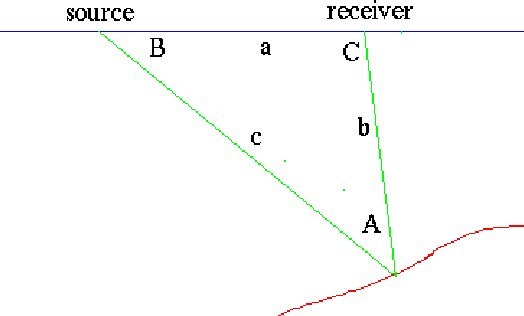
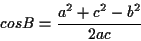
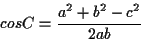
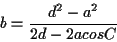
Referring to Figure 5, we can denote the distance travelled
by the ray from the source at B to the receiver at C by d :
This document was generated using the LaTeX2HTML translator Version 98.1 release (February 19th, 1998)
Copyright © 1993, 1994, 1995, 1996, 1997, Nikos Drakos, Computer Based Learning Unit, University of Leeds.
The command line arguments were:
latex2html -split 1 report.
The translation was initiated by Einar Kjartansson on 1998-06-21